



TDK SIM-CAL Studio Chip NTC Thermistor Simulation Tool
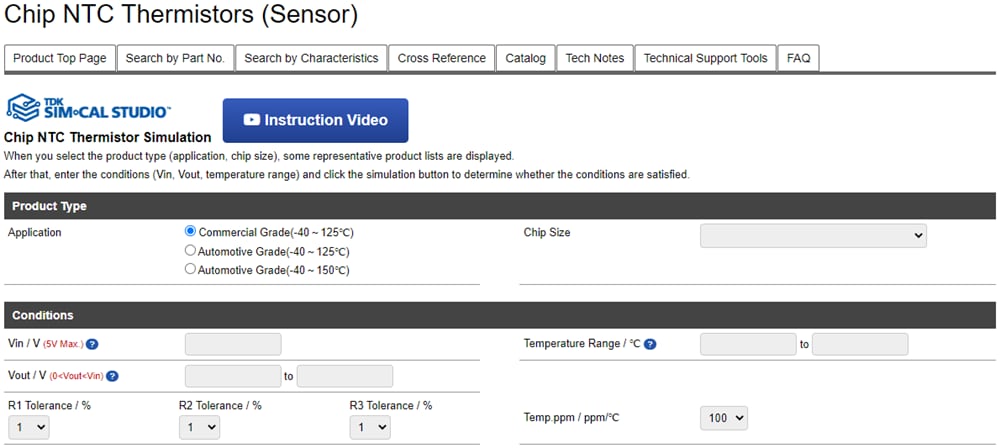
TDK SIM-CAL Studio Chip NTC Thermistor Simulation Tool provides part number recommendations and models up to 10 types of circuits, each with specific output characteristics. Users enter a product type and circuit condition information such as application type (automotive or commercial), NTC thermistor case size, Vin, Vout, resistor value or values, and temperature range. The tool shows which TDK part numbers match the selected conditions and the user can choose which circuits to simulate.
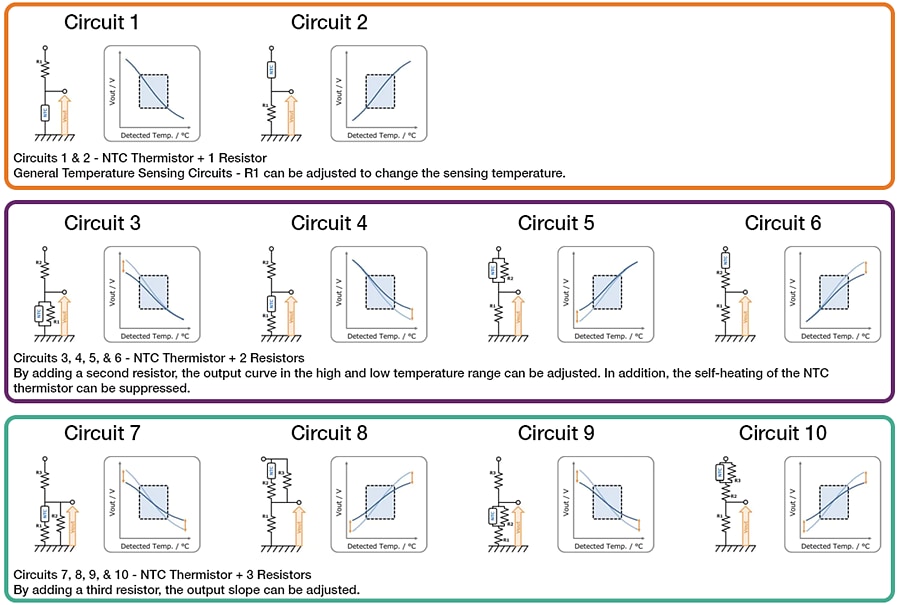
The circuits are classified into three groups, according to the number of resistors:
• Circuits 1 and 2 - NTC thermistor + 1 resistor: General temperature sensing circuit - R1 can be adjusted to change the sensing temperature.
• Circuits 3, 4, 5, and 6 - NTC thermistor + 2 resistors: By adding a second resistor, the output curve in the high- and low-temperature range can be adjusted. In addition, the self-heating of the NTC thermistor can be suppressed.
• Circuits 7, 8, 9, and 10 - NTC Thermistor + 3 resistors: By adding a third resistor, the output slope can be adjusted.
When the "simulate" button under the selected circuit model is clicked, a judgment is made on each of the matching part numbers. Performance graphs can also be displayed and compared for the recommended part numbers to determine which part best meets the application's needs. NTC thermistor tolerance and resistance value can also easily be modified at this point to view and check the new results.
Features
- Quick and easy product recommendations based on user-defined conditions
- Recommendations can be easily visualized and compared through performance graphs
- 10 types of circuits available for simulation
- Multiple performance graphs available, including Output Voltage, Self-Heating, Gain, Output Voltage Error, and Sensing Temperature Error
SIM-CAL Viewer Example
Tool Circuits
Commercial Applications

TDK B572xV2 SMD 0402 NTC Thermistors
Provides 150mW maximum power and ±1%, ±3%, or ±5% resistance tolerance in 0402 (1005) EIA case size.

TDK B573xV2 SMD 0603 NTC Thermistors
Temperature measurement up to 125°C, maximum 180mW power, and ±1%, ±3%, or ±5% resistance tolerance.

TDK B574xV2 / B57620C5 SMD 0805 NTC Thermistors
Features 210mW maximum power, ±3% or ±5% resistance tolerance, excellent long-term aging stability.
TDK B57621C5 SMD 1206 NTC Thermistors
Offers 300mW maximum power and a multilayer SMD NTC with or without inner electrodes.
TDK NTCG SMD NTC Thermistors
Wide range of resistances and B constants with high stability of resistance values after soldering.
Automotive Applications

TDK B572xV5 SMD 0402 NTC Thermistors
150mW maximum power and ±1%, ±3%, or ±5% resistance tolerance in a 0402 (1005) EIA case size.

TDK B573xV5 SMD 0603 NTC Thermistors
180mW maximum power and ±1%, ±3%, or ±5% resistance tolerance in a 0603 (1608) EIA case size.
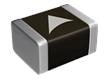
TDK B574xV5 SMD 0805 NTC Thermistors
210mW maximum power and ±3% or ±5% resistance tolerance in a 0805 (2012) EIA case size.
TDK NTCG SMD NTC Thermistors
Wide range of resistances and B constants with high stability of resistance values after soldering.

TDK NTCSP Automotive Chip NTC Thermistors
Semiconductor resistors with decreasing resistance characteristics with increasing temperatures.
NTC Thermistor Solutions
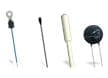
TDK Temperature Sensor Systems
Temperature sensor systems for commercial refrigeration and cooking appliances.

TDK Outdoor & Industrial LED Solutions with Lumileds
Features a broad range of inductors, capacitors, and protection devices for LED lighting technology,
Related Products
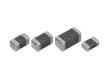
TDK SMD NTC Thermistors
Thermally sensitive semiconductive resistors designed for temperature measurement and compensation.